 EN
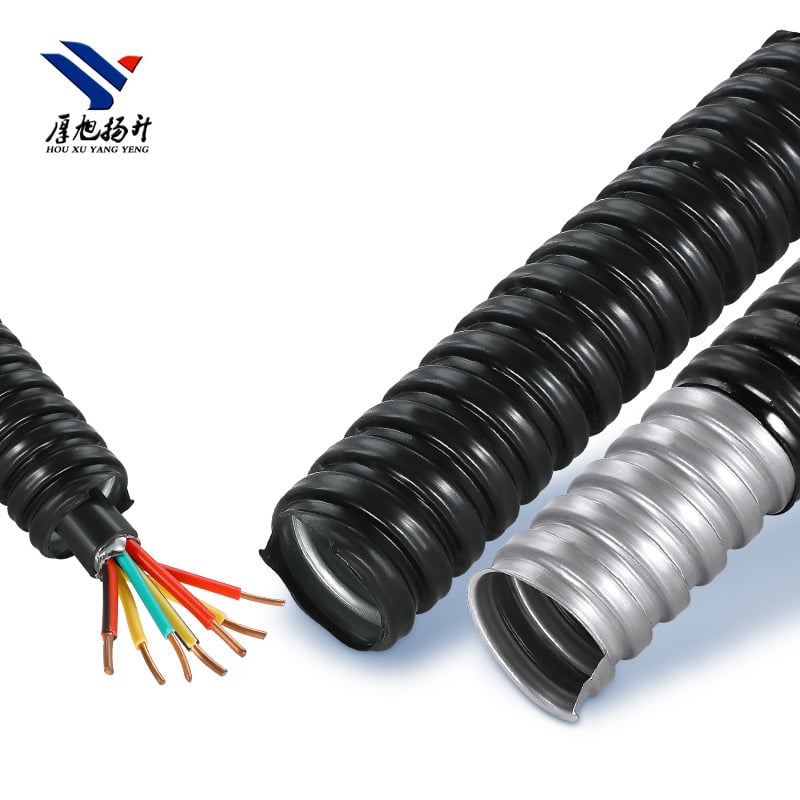

Which Material Is Best for Corrugated Pipe?
There is no best answer for corrugated pipe material selection. Right choice depends on your environment, expected temperature range, how often you will need to re-route or replace cables, etc. Working with customers for industrial, outdoor and process environment applications, the rule that holds is: buyers who want to avoid problems start with the environment and determine the material choice based on that, versus picking a material and hoping it works.
Start with Your Environment, Not the Product Label
Most buyers start by selecting a corrugated pipe and then checking whether it fits their installation path. The ones who avoid problems start by mapping out the key environmental factors — sustained temperature range, UV exposure, chemical contact, flexibility requirements, and how cables will be pulled through — and then let those factors drive the material selection.
Before choosing a material, answer these questions for your specific installation:
- What is the minimum sustained temperature this corrugated pipe will experience? Sub-zero cold storage, outdoor winter climates, and refrigeration plant rooms behave very differently from standard indoor panels.
- Is there direct UV exposure? Outdoor installations where corrugated pipe runs along rooftop cable trays or solar arrays require UV-stabilized material to maintain service life beyond two years.
- Will the conduit be near chemical exposure? Hydraulic oil, solvents, cleaning agents, or process fluids can degrade some materials quickly.
- Is a smooth inner bore needed for long cable pull runs? Cables pulled through corrugated pipe on longer runs benefit from a smooth inner surface that reduces friction.
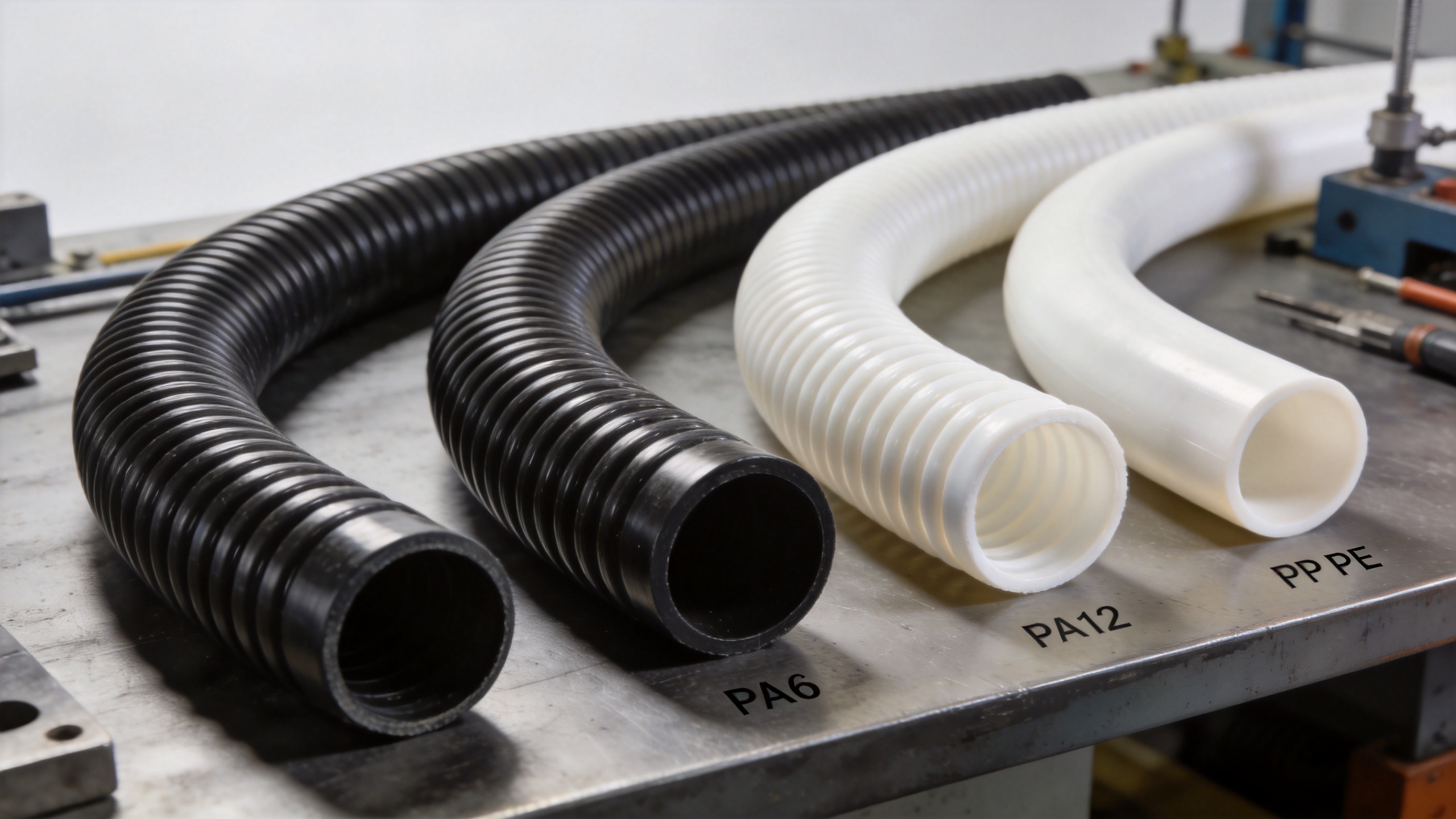
Common Corrugated Pipe Materials Compared
PA6 (Polyamide 6 / Nylon 6)
PA6 is the most common material used for flexible corrugated pipe in industrial cable protection systems. Standard grades of PA6 have a use temperature of about -40°C to +120°C. Higher temperature variants are available. PA6 is quite ductile and resistant to abrasion from movement of the cables.
Where there is chemical exposure, standard PA6 loses its ductility and becomes very brittle. Higher temperature PA6 variants may be used in these cases. Standard PA6 also absorbs moisture and loses dimensional stability, which is even more pronounced with PA12. In cold storage facilities below -20°C, standard PA6 becomes brittle and breaks during installation or with repeated exposure to high and low temperatures during thermal cycling. This failure mode becomes evident a few months after commissioning.
PA12 (Polyamide 12 / Nylon 12)
PA12 is the upgrade path when PA6 reaches its environmental limits. Lower moisture absorption, better resistance to hydraulic oils, fuels, and a wider range of cleaning agents, and retained flexibility at lower temperatures are the practical differences. For outdoor installations, coastal environments, and food processing or chemical plant wiring, PA12 tends to be more reliable, even at a higher unit cost.
UV-stabilized PA12 grades are available for installations with sustained outdoor exposure. The cost premium over PA6 pays back when you compare it against the alternative: re-specifying and replacing degraded corrugated pipe runs within two years rather than serving an expected ten-year-plus service life.
PP (Polypropylene)
PP corrugated pipe works well when chemical resistance is the primary requirement and temperature range is moderate. It handles alkaline cleaning agents and many industrial fluids that would affect PA materials. Standard grades typically run from around -20°C to +100°C.
PP is somewhat less flexible than PA at lower temperatures and has lower abrasion resistance. For applications where cables are pulled through the pipe repeatedly, PA materials hold up better at the inner bore contact points. If chemical resistance is the priority in a moderate-temperature environment, PP is worth evaluating alongside PA12 on both performance and cost.
PE (Polyethylene / HDPE)
PE and HDPE corrugated pipe is most commonly specified for civil drainage and underground conduit applications rather than flexible cable protection in industrial enclosures. HDPE dual-wall corrugated pipe offers good impact resistance for buried conduit runs, where the corrugated outer wall structure and smooth inner bore make cable pull-through manageable on long runs.
For indoor industrial cable management or flexible panel wiring connections, PA-based materials are the more practical fit. PE becomes relevant when the application involves buried routes, outdoor cable routing close to grade, or below-ground conduit systems where impact protection and drainage compatibility matter alongside cable protection.
PVC (Polyvinyl Chloride)
Standard PVC corrugated pipe comes in at lower cost but imposes significant temperature and flexibility limits. PVC becomes brittle at low temperatures and softens near heat sources, making it unsuitable for industrial environments with temperature variation. Its use is generally limited to light-duty cable management in controlled indoor environments with a narrow temperature range and no chemical exposure. For any application outside of general-purpose light commercial use, these constraints are worth accounting for in the total cost calculation.
Application-Based Recommendations
Matching material to environment is the core of corrugated pipe selection. A few patterns emerge across different installation types:
- Standard industrial indoor: PA6 covers the majority of typical indoor panel-to-equipment connections. Where there's no chemical exposure and temperatures stay within -20°C to +100°C, PA6 is generally the cost-effective default.
- Outdoor and UV-exposed installations: UV-stabilized PA12 or PP. Standard PA6 breaks down faster than expected under sustained UV and weather cycling. On outdoor solar installations, rooftop panel connections, and exposed cable trays, material grade matters more than pipe diameter.
- Cold storage and sub-zero environments: Low-temperature grade PA12 or flexible PE formulations. Standard PA6 and most standard-grade PP materials become brittle in sustained temperatures below -20°C. Specify low-temperature grades explicitly rather than relying on a standard-grade material's nominal minimum temperature rating.
- Chemical exposure: PA12 for resistance to oils and fuels; PP for resistance to alkaline cleaning agents and specific industrial fluids. The specific chemical determines which material family fits — the material's chemical resistance table is worth checking against the actual substances present.
- High-temperature zones near heat sources: High-temperature PA variants rated above 120°C for sustained service. Engine rooms, boiler rooms, and process plant areas where standard materials soften require confirmed high-temperature grades rather than standard catalog items with an assumed temperature buffer.
What the Selection Decision Comes Down To
Prior to a coastal food processing project, PA6 was the default specification for corrugated pipe installations. During that project, standard nylon was rapidly degraded by a combination of UV light and a chemical rinse. This project changed the default specification to PA12 or PP for the food processing industry and other outdoor applications. The difference in price between PA6 and PA12 becomes marginal when the cost of labor to replace degraded conduit is considered.
The temperature rating on a spec sheet is typically the first consideration for material selection, and for most standard industrial applications, PA6 corrugated pipe is an inexpensive option. Consideration should be given to materials when the application involves outdoor exposure, extremes in temperature, chemical contact, or thermal areas. Conduit is often installed correctly, but specifying the wrong material for a given application creates a more expensive problem, i.e. the need to replace the conduit.
When you need to specify the correct corrugated pipe for a given application, Solithos offers PA6, PA12, PP, and PE pipe for various application conditions in English.