
 EN
EN
Is Split Wire Loom Flame Retardant?
A commercial bakery in the Netherlands operating a 24-hour industrial production line experienced a control panel fire that shut down the facility for 11 days. The fire investigation traced the ignition to an overheated relay contact inside a control cabinet, where the heat generated by the failing contact transferred to a non-flame-retardant split wire loom sleeve that bundled the cabinet's 24V control wiring. The sleeve — made from standard PP (polypropylene) with no flame retardant additives — ignited at approximately 340°C, and the vertical orientation of the bundled wiring in the cabinet created a chimney effect that carried flames upward through the loom to adjacent cable bundles within 40 seconds. The fire was contained to the single panel by the cabinet's metal enclosure, but the smoke damage to all internal wiring required full replacement of 480 control cables, 22 terminal blocks, and 4 PLC modules. After the rebuild, the bakery specified that all split wire loom used in control cabinets must carry UL94 V-0 certification — a requirement the facility's procurement team had previously considered "optional" for indoor electrical applications.
Split wire loom is flame retardant when manufactured from UL94 V-0 rated nylon (PA66) with halogen-free flame retardant additives. Whether a specific split wire loom product meets fire safety standards depends entirely on the base polymer, the additive package, and whether the material is virgin resin or regrind.
Understanding the UL94 Flame Retardant Classification
The UL94 standard — developed by Underwriters Laboratories — is the international benchmark for testing the flammability of plastic materials. The test involves mounting a standardized specimen vertically, applying a calibrated flame to the bottom edge for 10 seconds, removing the flame, and observing the burning behavior. The rating assigned depends on three criteria: the afterflame time (how long the specimen continues to burn after flame removal), the afterglow time, and whether flaming drips ignite a cotton indicator placed below the specimen.
A UL94 V-0 rating — the highest standard for general-purpose plastic enclosures and conduit — requires that the specimen self-extinguish within 10 seconds of flame removal, that the total afterflame time across 10 flame applications does not exceed 50 seconds, and that no flaming drips fall from the specimen. A split wire loom carrying V-0 certification will not sustain combustion independently — once the external flame source is removed, the material stops burning. A V-2 rating allows longer afterflame time (30 seconds per application) and permits flaming drips. An HB (Horizontal Burn) rating — the lowest classification — applies to materials that burn slowly in a horizontal orientation but have no vertical flame resistance, and these materials are unsuitable for any application where wiring is routed vertically.
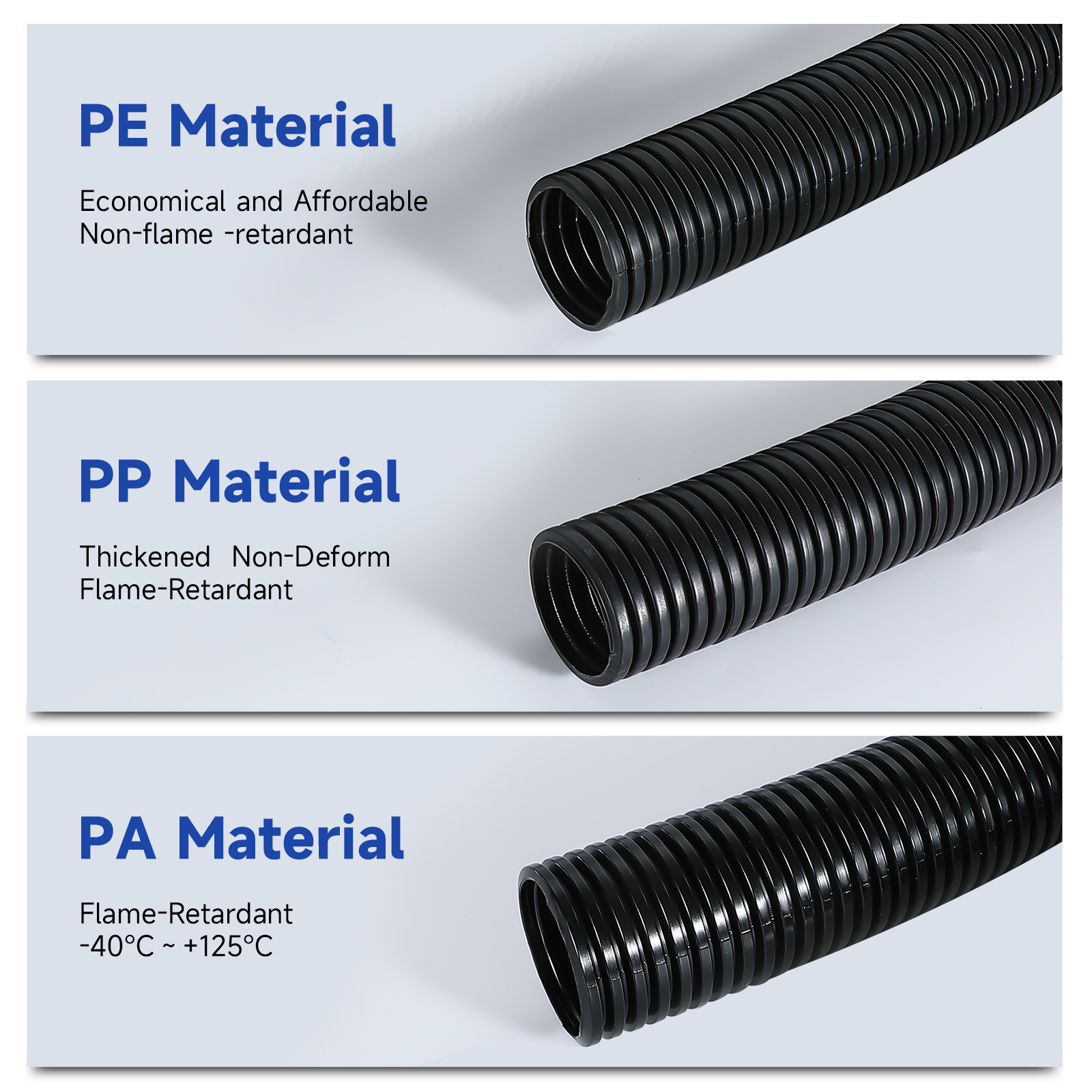
Standard polypropylene (PP) split wire loom without flame retardant additives typically achieves only HB or, at best, V-2 ratings. It burns readily, produces flaming drips, and will continue burning after the ignition source is removed. This is the material type that represents a genuine fire hazard in enclosed electrical enclosures where heat buildup from equipment can bring internal temperatures close to material ignition points.
The Material Science — Virgin PA66 vs. Recycled and PP Alternatives
The flame retardant performance of a split wire loom is determined at the molecular level. PA66 nylon — polyamide 66, the condensation polymer of hexamethylenediamine and adipic acid — has an inherently higher ignition temperature than polypropylene (approximately 420°C versus 340°C) and a higher Limiting Oxygen Index (LOI) — the minimum oxygen concentration required to sustain combustion. PA66 has an LOI of approximately 24-28, meaning it self-extinguishes in normal atmospheric oxygen (21%); polypropylene has an LOI of 17-18, meaning it burns readily in air.
However, even virgin PA66 alone does not achieve V-0 certification. The V-0 rating requires halogen-free flame retardant additives — typically phosphorus-based compounds or nitrogen-based melamine derivatives — compounded into the polymer during extrusion. These additives function through two mechanisms: intumescence (the additive swells and forms a char layer that insulates the underlying polymer from heat and oxygen) and radical scavenging (phosphorus radicals interrupt the free-radical chain reaction of combustion). The additive package must be precisely formulated because excessive loading degrades the mechanical properties of the nylon — flexibility, impact resistance, and tensile strength — that make split wire loom effective as a cable protection product.
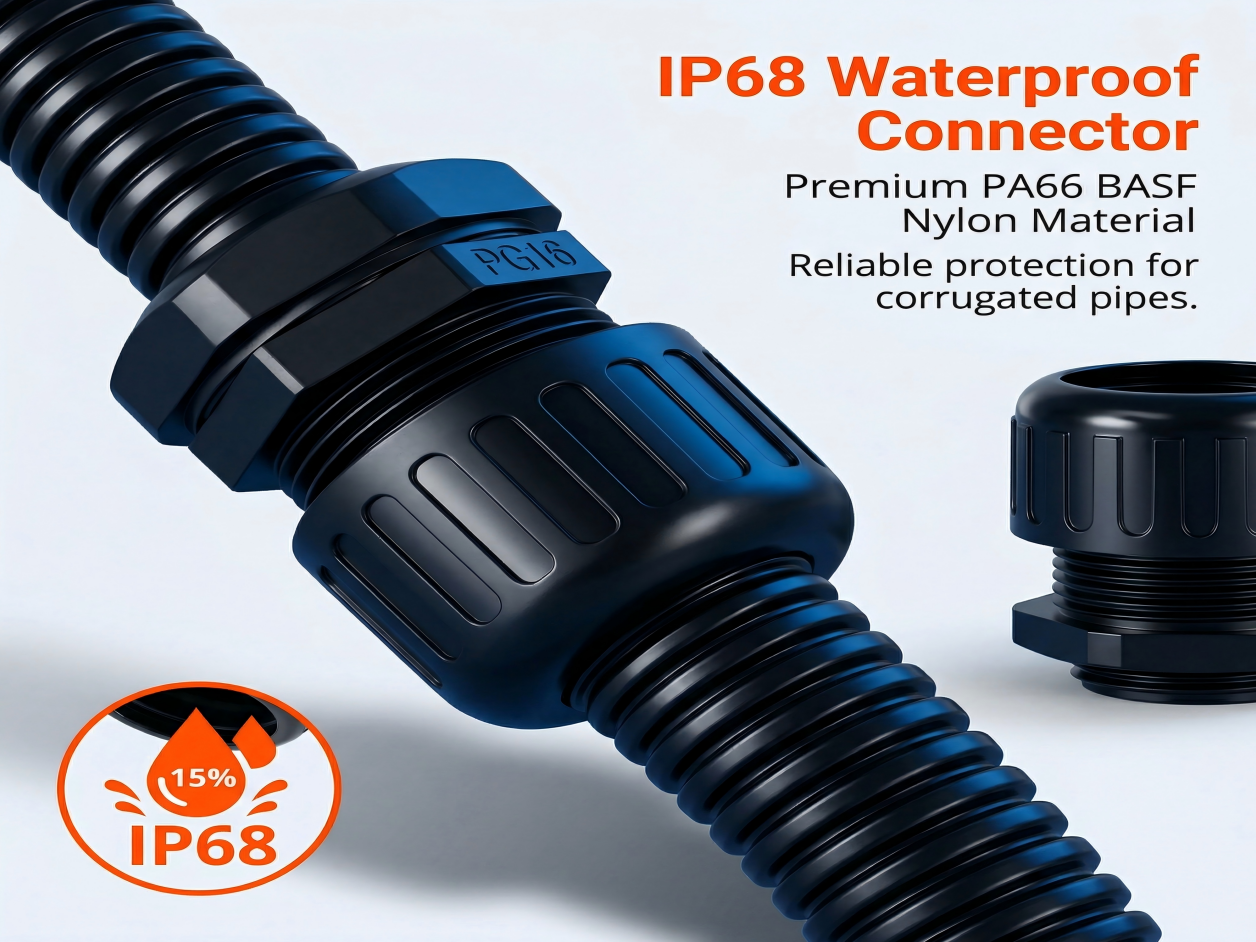
The distinction between virgin and recycled PA66 is critical for flame retardant performance. Virgin PA66 — such as BASF Ultramid resin — has a known, consistent molecular weight distribution and predictable additive dispersion. Recycled PA66, produced by re-melting post-industrial or post-consumer nylon waste, has an unpredictable molecular weight due to thermal degradation during previous processing cycles (each re-melting cycle reduces the average chain length by approximately 5-15%). Shorter polymer chains produce a weaker char layer during combustion, reducing the material's ability to self-extinguish. A split wire loom made from 100% virgin PA66 with V-0 certification will reliably self-extinguish within 10 seconds; a loom made from regrind material — even if labeled "PA66" — may burn for 20-30 seconds or produce flaming drips that propagate the fire to adjacent materials.
Where Flame Retardant Certification Is Mandatory
The requirement for flame retardant split wire loom varies by application and jurisdiction. Industrial control panels built to IEC 61439-1 standards in the European Union typically require all internal wiring management products to meet glow-wire test requirements (IEC 60695-2-11) at 650-960°C depending on the current rating of the enclosed equipment — a test that non-flame-retardant PP products cannot pass. Automotive wiring harnesses built to ISO 6722 require the conduit material to meet specific flame propagation limits tested per ISO 3795. Railway applications governed by EN 45545-2 require R22/R23 hazard level compliance, which effectively mandates V-0 rated materials for interior cable protection. Renewable energy installations — solar inverters, wind turbine nacelles, battery energy storage enclosures — increasingly specify V-0 rated cable management products as insurance requirements tighten for assets with high fire consequence costs.
Selection Guidance
Procurement teams evaluating split wire loom should verify three items: the UL94 certification document showing the specific rating (V-0, not V-2 or HB) with the test report number; the material composition statement confirming 100% virgin PA66 nylon with halogen-free flame retardant additives; and the manufacturer's ISO 9001 quality management certification, which provides traceability from raw material batch to finished product.
Frequently Asked Questions
What does UL94 V-0 mean for split wire loom?
UL94 V-0 means the material self-extinguishes within 10 seconds after a 10-second flame application, with total afterflame time under 50 seconds across 10 tests, and produces no flaming drips. A V-0 rated split wire loom will not sustain combustion after the external flame is removed and will not propagate fire to adjacent materials through dripping.
Can standard polypropylene split wire loom be flame retardant?
Standard PP without flame retardant additives achieves only HB or V-2 rating — it burns readily, produces flaming drips, and continues burning after flame removal. PP can be compounded with flame retardants to achieve V-2 (sometimes V-0 in thick sections), but the additive loading required typically makes the loom stiff and brittle, reducing its utility as flexible cable protection.
How can buyers verify a split wire loom is genuinely V-0 rated?
Request the UL94 test report with the specific product name, lot number, and testing laboratory identification. Cross-reference the report's material composition (100% virgin PA66 with specified flame retardant) against the supplier's material data sheet. Perform a simple field test: apply a lighter flame to a sample for 5 seconds — a V-0 material self-extinguishes almost immediately upon flame removal, while non-retardant material continues burning independently.
Is flame retardant split wire loom more expensive than standard loom?
V-0 rated PA66 split wire loom costs approximately 25-40% more than standard PP loom and 10-20% more than non-retardant PA66. The premium covers the cost of virgin BASF-grade resin and halogen-free flame retardant additives. The cost difference is negligible compared to the potential cost of a single fire incident in an industrial control panel — often exceeding $50,000 in equipment replacement and downtime.
What temperature range can flame retardant split wire loom withstand?
V-0 rated PA66 split wire loom operates continuously from -40°C to 125°C with short-term tolerance to 150°C. Below -40°C, PA66 becomes brittle and may crack during installation flexing. Above 125°C sustained, the polymer begins thermal degradation that reduces mechanical strength over time and can compromise flame retardant performance.
Where is flame retardant split wire loom required by code or standard?
Mandatory applications include: railway interiors (EN 45545-2 R22/R23), industrial control panels above certain current ratings (IEC 61439-1 with glow-wire test), automotive engine compartment wiring (ISO 6722/ISO 3795), and renewable energy enclosures where insurance requirements mandate V-0 materials. Commercial building electrical rooms increasingly specify V-0 cable management in fire-rated construction assemblies.