
 EN
EN
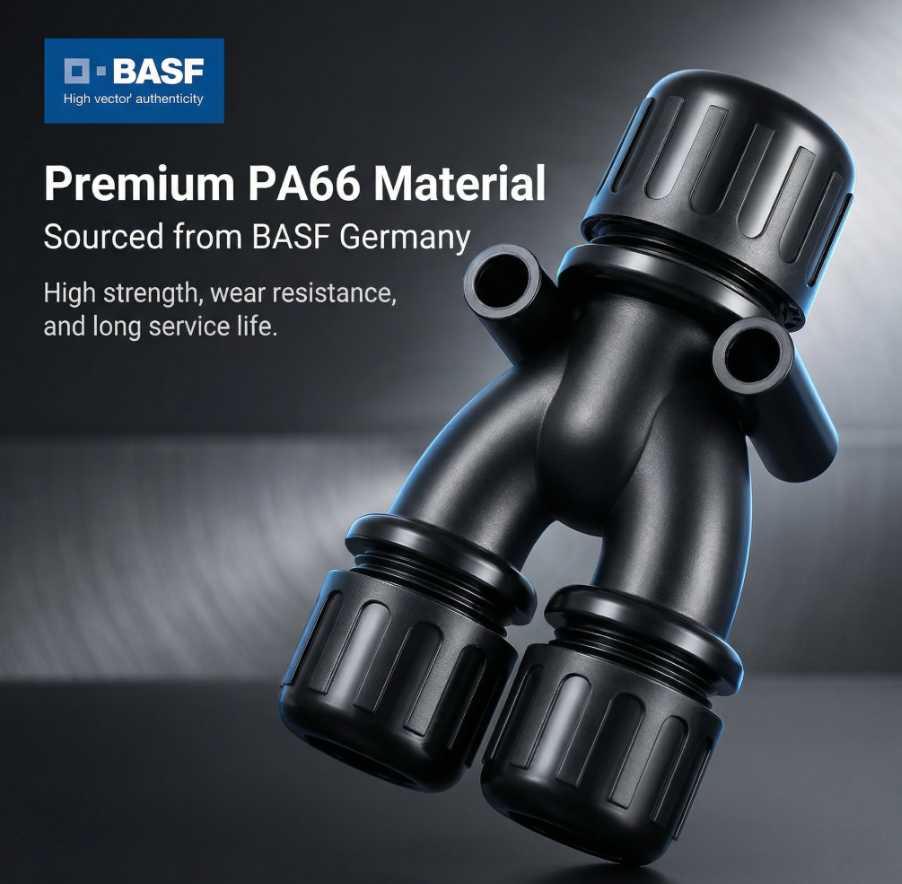
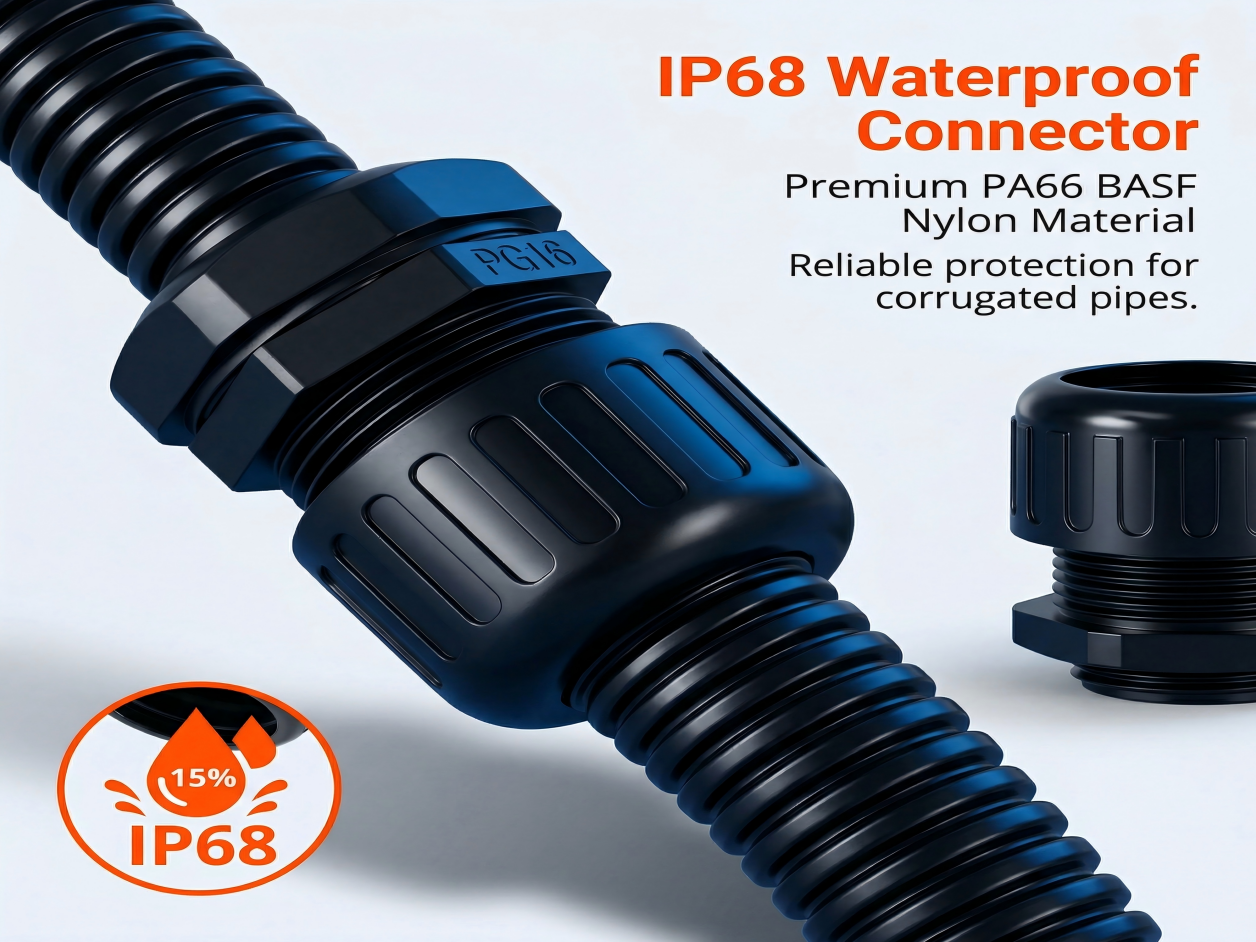

A manufacturer of industrial HVAC control panels faced a recurring design constraint: their standard panel layout required multiple cable branches to route sensor wiring from a central PLC to temperature and humidity sensors distributed across air handling units. Each branch point required a metal junction box — a 100mm × 100mm × 60mm enclosure containing DIN-rail terminal blocks, a section of DIN rail, and cable entry connectors on each face. A typical 24-sensor panel configuration required 16 junction boxes consuming approximately 384,000 cubic centimeters of internal panel volume and adding 128 separate wiring components (connectors, terminal blocks, wire jumpers) to the bill of materials. The redesign replaced all 16 junction boxes with IP68 waterproof 3 way connector fittings — T-type PA66 nylon connectors that split a single incoming conduit into two outgoing branches at each sensor branch point. The connectors occupied approximately 80 cubic centimeters each (1,280 cc total versus 384,000 cc), eliminated 96 terminal block connections (reducing potential failure points by 75%), reduced total wiring component count from 312 to 187 (40% reduction), and freed sufficient panel volume to accommodate two additional control modules that previously required a separate auxiliary enclosure.
A 3 way connector simplifies wiring layout by enabling conduit-level branching that replaces the traditional junction-box-and-terminal-block approach to cable distribution. The connector creates a sealed, mechanically secure, and electrically continuous branch point directly in the conduit network — no junction box, no terminal block, no additional enclosure penetrations.
How Topology Changes With Conduit-Level Branching
Traditional industrial wiring follows a star topology: every cable runs directly from the central control cabinet to its destination device. Each cable occupies a dedicated conduit run, and the number of conduit entries into the control cabinet equals the number of connected devices. This topology maximizes cable consumption, panel space utilization, and installation labor because every device requires a home-run conduit.
A tree topology — enabled by 3 way connector fittings — routes a main trunk conduit from the control cabinet and branches it at each device cluster location. A trunk conduit carrying four cables enters a T-type three-way connector; two cables continue along the trunk to the next branch point, and two cables exit through the branch port to serve the two devices at this location. The number of conduit runs is reduced to approximately the number of branch points plus one (the initial trunk), rather than one per device. For a system with 16 devices grouped in four clusters of four devices each, the star topology requires 16 conduit runs; the tree topology with 3 way connectors requires 5 runs (one trunk + four branch drops) — a 69% reduction in conduit length and a corresponding reduction in conduit connectors, mounting hardware, and installation time.

The critical enabler of conduit-level branching is the connector's ability to maintain sealing integrity at the branch point. A T-type 3 way connector — with one inlet port and two outlet ports arranged in a T-shaped geometry — provides three separate conduit terminations, each with its own internal sealing gasket. The connector body is injection-molded as a single piece from PA66 nylon with three threaded or quick-lock ports. An IP68 waterproof version adds O-ring or gasket seals at each port interface. The maximum tensile load the branch connection can sustain depends on the connector's material strength and the locking mechanism design — a PA66 T-connector with threaded compression nuts on each port typically withstands 80-120 Newtons of axial pull force before the conduit separates from the connector body, compared to 150-200N for a straight inline connector with the same thread design.
Y-Type vs. T-Type Configuration
The geometry choice between T-type and Y-type 3 way connector fittings affects both installation space and cable routing. A T-type connector has ports at 0°, 90°, and 180° — the classic T-shape — and is the default choice for most panel and machine wiring where branches depart at right angles from the trunk. The right-angle geometry is space-efficient in rectangular enclosures and along machine frames. A Y-type connector has ports at approximately 0°, 45°, and 135° — the trunk enters at the stem, and two branches exit at equal angles, forming a Y-shape. The Y configuration is preferred when both branches must route in the same general direction (forward, not sideways) and when a more gradual cable bend radius is desired to reduce strain on the cable at the branch point.
Application Value
The highest-value application for 3 way connector fittings is control panel internal wiring, where panel volume is expensive real estate. Every cubic centimeter freed by eliminating a junction box is available for additional control components or for improved airflow for thermal management. The second-highest-value application is automotive wiring harnesses, where the vehicle's confined spaces — inside door panels, under dashboard assemblies, along chassis rails — make traditional junction boxes physically impossible. An automotive wiring harness uses dozens of T and Y connectors to branch sensor, actuator, and power wiring throughout the vehicle, with each connector ultrasonically welded or clipped to the harness structure. Industrial machinery and outdoor electrical installations benefit from the reduced enclosure count (fewer enclosures mean fewer IP-rated penetrations to seal and fewer potential leak points).
Selection Guidance
When selecting a 3 way connector for industrial wiring, verify: the connector's IP rating matches the installation's worst-case moisture exposure; the body material (PA66 for general, metal for high-impact) is compatible with the conduit material and the installation environment; the port thread types or quick-lock sizes match the conduit diameters at all three ports (trunk ports may be larger diameter than branch ports); and the connector's UL94 flame rating meets the installation's fire safety requirements — V-0 for occupied building interiors and railway vehicles.
Frequently Asked Questions
What is the difference between a T connector and a Y connector?
A T connector has ports at 0°, 90°, and 180° — a right-angle branch from a straight trunk — and is best for rectangular enclosures and machine frames. A Y connector has ports at approximately 0°, 45°, and 135° — both branches route forward at equal angles — and is preferred when both branch cables must travel in the same general direction with a gentler bend radius.
Can a 3 way connector maintain waterproof sealing at all three ports?
Yes. An IP68-rated 3 way connector uses individual O-ring or gasket seals at each of the three ports. Each seal seats into the corrugation valley of the connected conduit and is compressed by the port's compression nut or locking ring. The single-piece molded nylon body eliminates seam leakage paths. Testing verifies no water ingress at any port after 30 minutes at 1 meter depth.
How much space does a 3 way connector save compared to a junction box?
A T-type PA66 3 way connector occupies approximately 60-100 cubic centimeters. A typical small junction box (100mm × 100mm × 60mm) occupies 600,000 cubic centimeters — roughly 6,000-10,000 times more volume. In a control panel with 16 branch points, replacing junction boxes with 3 way connectors reduces occupied volume from approximately 9.6 million cubic centimeters to 1,600 cubic centimeters.
What is the maximum number of cables a 3 way connector can branch?
A standard 3 way connector splits the conduit — not individual cables — so the number of cables branched equals the conduit's cable fill capacity. A single conduit typically carries 3-8 cables depending on diameter and fill ratio per IEC 60470. A 4-way or multi-port connector can create a star branch from a single point but requires a larger connector body and introduces more sealing interfaces.
Are 3 way connectors strong enough to support the conduit weight?
PA66 3 way connectors with threaded compression nuts resist 80-120 Newtons of axial pull force per port — sufficient for conduit runs up to 3-5 meters horizontally or 1-2 meters vertically without additional support. Longer runs require intermediate support brackets, with the connector serving as a branch point only, not a structural support element.
Can 3 way connectors be used with different conduit materials at each port?
Yes, the port sealing gasket interfaces with the conduit's exterior geometry, not its material. A PA66 3 way connector can connect PA66 conduit on the trunk port and PE or PP conduit on the branch ports, provided all conduit diameters fall within the connector's specified size range. Metal conduit can also be connected if the conduit's outer diameter matches the connector's port specification.